Our first exhibition in 2024 will be Disturb by Frances Aviva Blane, whose dramatic paintings attract such attention that at exhibitions I have noted people lingering next to them, as though unwilling to leave their presence.
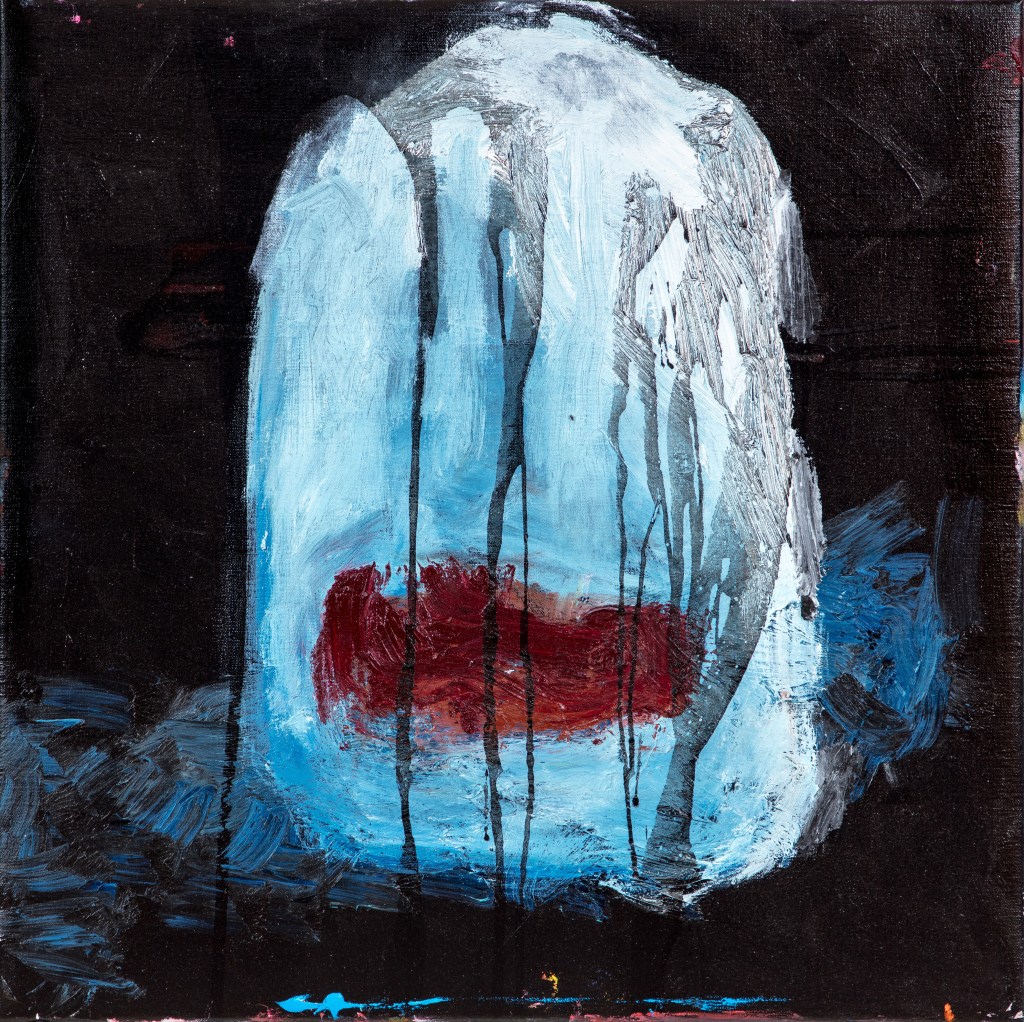
“Anguish writ large”and “disturbing yet compelling” are descriptions of Blane’s paintings by psychoanalyst Susie Orbach. According to critic Anna McNay, even Blane’s father used to say he was afraid to sleep in a room with her paintings. This comes from a perceptive essay in the catalogue “dark.” by McNay, a curator, editor and writer who is also known as TheCriticWithTheDog as she lives in the woods with her emotional support dog Parsley.
The essay opens dramatically and the pace is maintained throughout: “Everyone is afraid of the dark. Some of the literal, poetic dark: the tenebrous bedroom, when we are unable to sleep, or when closing their eyes to a further level of darkness is too much for the anxious child; the nail-biting television crime scene, which the detectives seem always to enter with feeble torches, unable to spot the villain lurking in the gloaming; or the crepuscular night, especially in an unknown place or fairy-tale forest.”
Disturb will open on May 8th, with a PV on 5th, and close on June 15th.
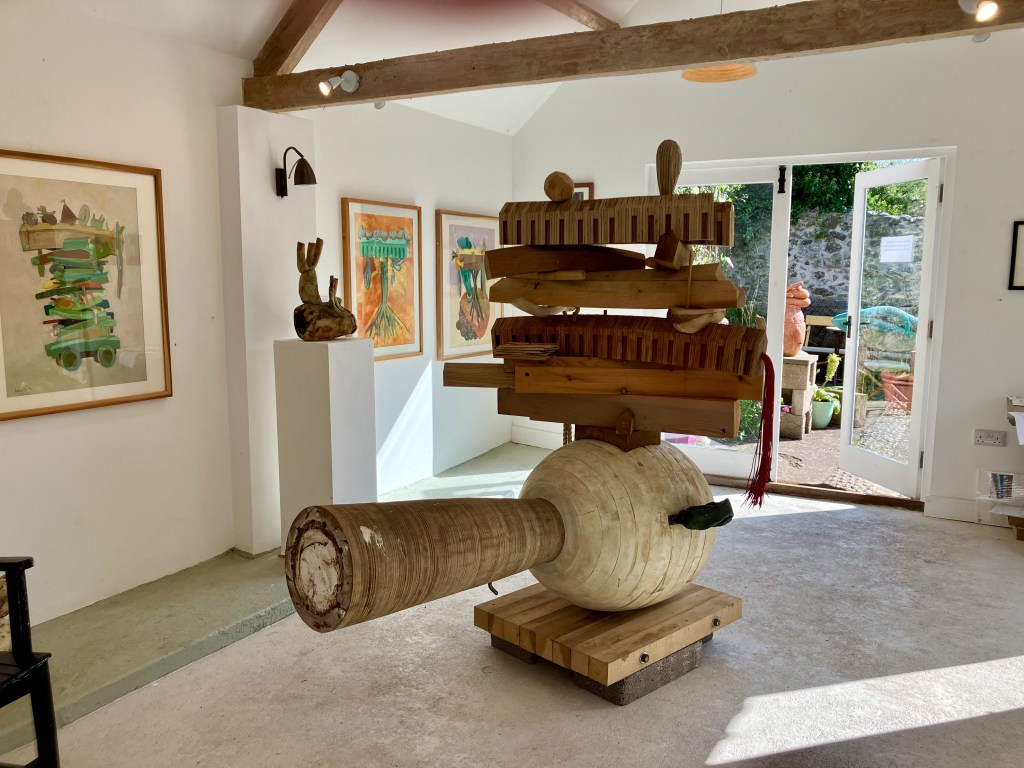
CONTEMPORARIES: MICHAEL CROWTHER & DAVE KING
Michael Crowther and Dave King met at Leeds College of Art in the mid Sixties and their lives have followed similar trajectories through studio practice, college teaching, examining and exhibiting. They showed together in the Paris Biennale in 1980, in The British Art Show 1 and again in Tampere, Finland. Both are represented in the National Arts Council Collection.
Crowther taught painting at Cardiff School of Art and Design and now lives in York. King taught sculpture principally at Bath Academy and West Surrey College of Art & Design and the Shippon Gallery is at his home in Devon.
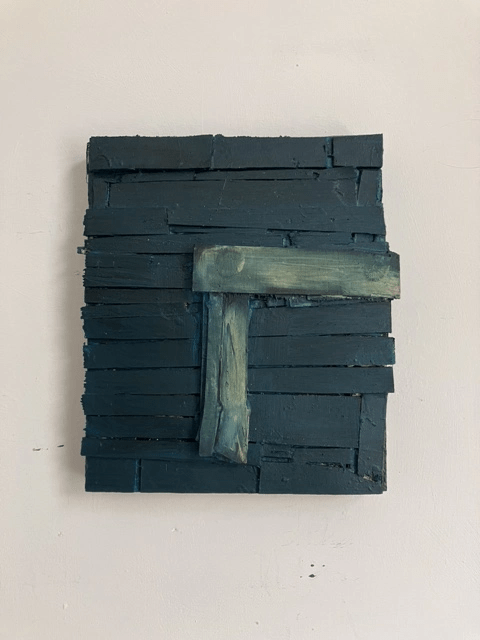
Michael Crowther explains his paintings well, so I will give this verbatim:
For a long time I have worked with paintings in series. This was the case in the seventies and eighties when I made huge paintings and it’s certainly the case now when the works are small (increasingly small) in scale.
The paintings are made wet into wet, oil paint on birch ply. During the making the paintings are subject to much change and mobility. In most cases the final image emerges after an eleventh hour scrape or wipe off.
In as much as “subject” can be separated from the actual making, recent works have reengaged with preoccupations I had during the nineteen eighties and which seem now to have been incubating over the intervening period. This I am sure has been provoked by a move back to the north of England.
Sometime around 2019/20 I made a number of reliefs, thin birch ply glued to panel, fast drying (acrylic) paint applied throughout, a process clearly distinct from my usual painting method – see top image. A ramshackle quality emerged which at the time I welcomed. I made too many of these works but in some odd way they have acted as catalyst to subsequent paintings.
There are several titles I have in mind as I am working, which runs of paintings hover around; specific place names like “Bollihope” or “Scarboro”, other titles are more elusive, even evasive, “Amongst Farm Horses’, “Off”, “Farmers Boy”.
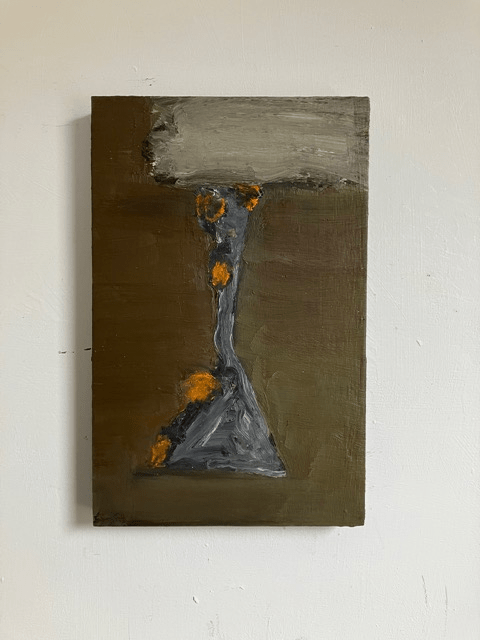
This exhibition includes rarely seen works by King. The largest – “Think Slow, Act Fast” – was completed in 2019 and was commissioned by the Devon Guild of Craftsmen and Libraries Unlimited for a project called A Good Age. It is a reflection on ageing and the accumulation of experience over a lifetime and incorporates an earlier sculpture at its base. The second early work is the photographic record of a participatory sculpture made in West Cork for Angela Flowers. It was built in 1996 and restored around 2010.
11am – 4pm Friday to Sunday & other times by appointment: 01460 220021
Until October 15th.
We Work in the Dark: Natalka Liber Stephenson & Dave King
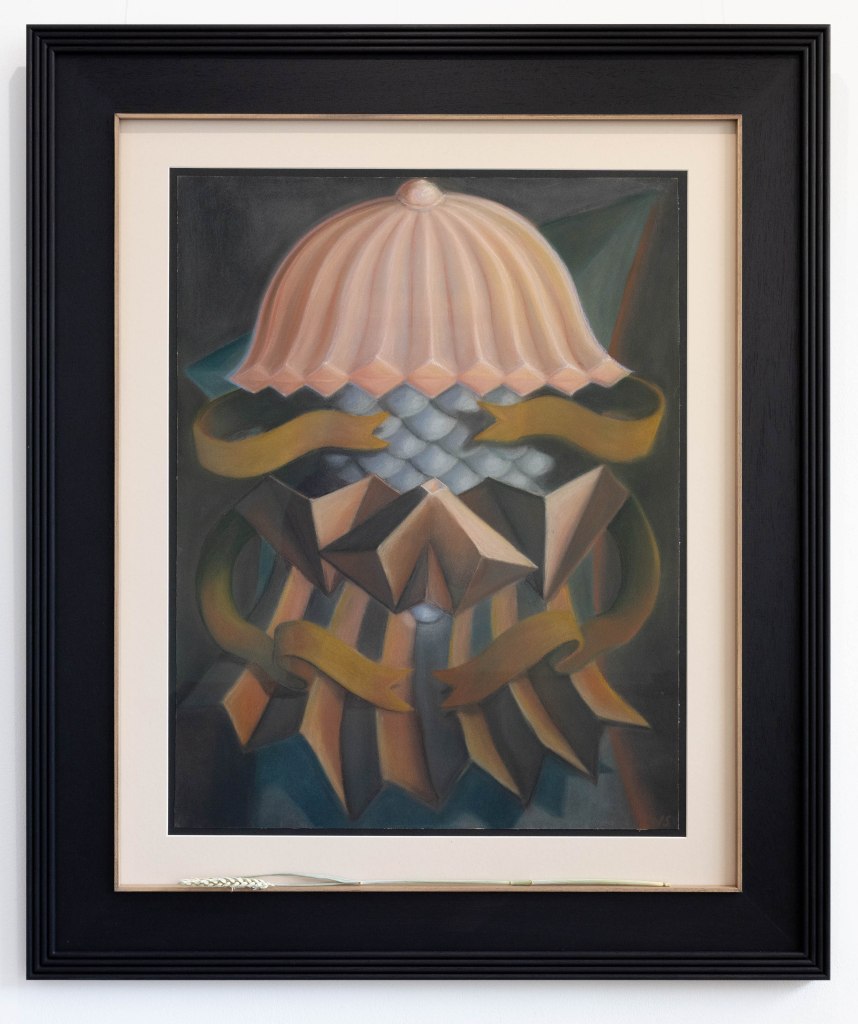
Natalka Liber Stephenson utilises dream imagery to interpret sensations of estrangement or anxiety around human action and casts an uncanny lens over day to day observations. Her practice, strongly founded in experimental drawing, is used as a process of discovery, scratching out remnants from a liminal other-world and coaxing her subject to emerge from the miasma of fantasy and memory.
The works presented in We Work In the Dark are predominantly soft-pastel drawings on paper from her Kite series, depicting kites as surreal sentient ornaments. These originally emerged during lockdown in 2020 and were interpreted by the artist as a totemic portent of change and transformation.
Natalka grew up in London where she received her MA from the Royal College of Art. She now lives in Ramsgate, Isle of Thanet.
http://www.natalkaliberstephenson.com
Patrick Jones & Dave King – Experienced Eyes
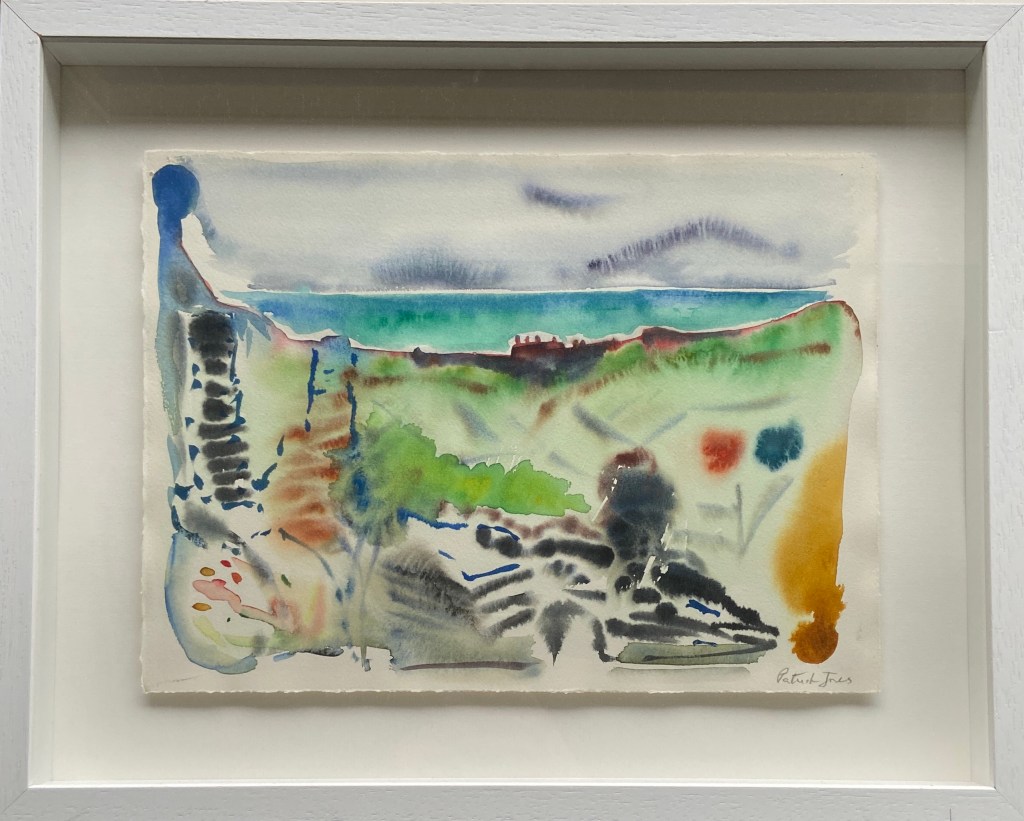
Blue Moon by Patrick Jones
Dave King and Patrick Jones met in New York in the 1980s. King was there for the summer, building a large sculpture at Socrates Sculpture Park, and a photograph of this is included in the exhibition. Jones spent a decade in New York – working, teaching and exhibiting with success until family circumstances caused him to return to England in 1991.
According to Lionel Phillips, “In Jones’s paintings colour and drawing are inextricably bound together in a gritty lyricism.” Jones has said of his engagement with painting: “Improvisation is my method, the studio a sanctuary from the outside world.”
Mel Gooding has praised Jones for being constantly experimental and self-questioning. He believes he has a distinguished place in British colour abstraction: “He is widely admired for his painterly virtuosity, and above all for the vibrancy of his colour and the boldness of his formal invention.”
ANDREW LANYON & DAVE KING: A DINNER-GONG IN THE JUNGLE
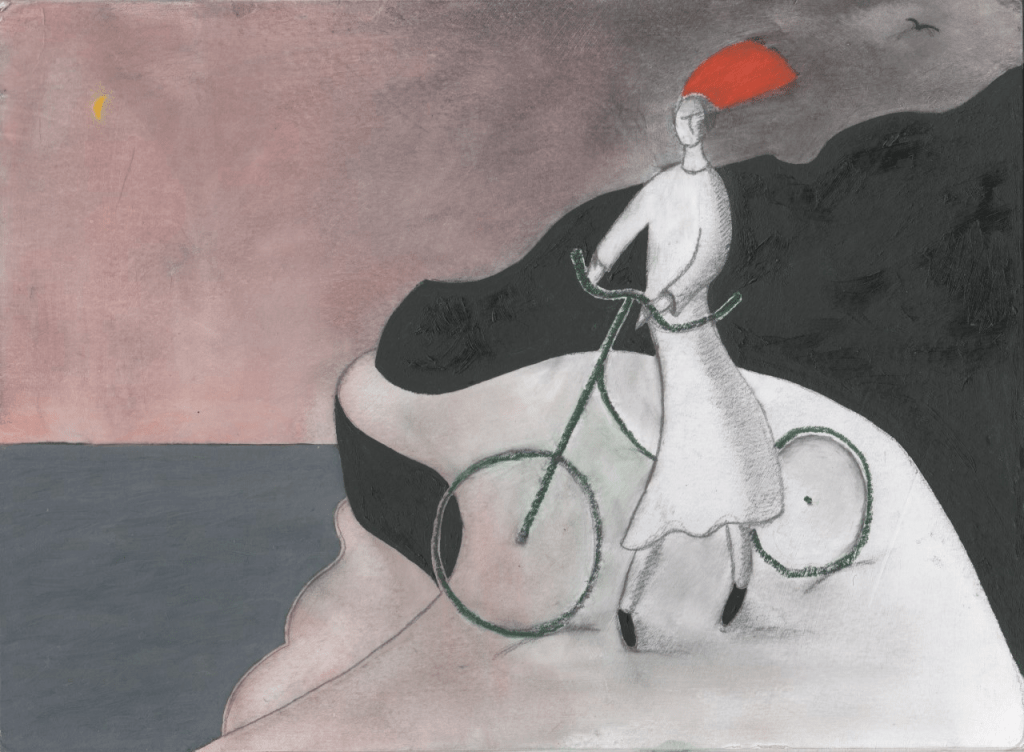
Cornish painter, author and filmmaker Andrew Lanyon takes humour seriously. Writing about laughter he said, “Maybe it used to be an alarm, a dinner-gong in the jungle, one sounded to draw the rest of the tribe close to protect us from predators while we devoured the beast we’d clubbed to death.” This exhibition of small paintings, “hollow books” and illustrated books and gives an insight into his take on today’s world and the past.
Lanyon’s trajectory of interests took him from conjuring at 7, via photography and filmmaking, to a preoccupation with humour: “I suppose magic tricks and comedy both ‘pull the wool’. So maybe I’ve been going from sleight of hand to sleight of mind.” Narrative paintings often feature characters associated with his home town of St Ives in the 1930s, although scenarios are fictitious: the fisherman-turned-painter Alfred Wallis is seen “discovering” artists Ben Nicholson and Kit Wood rather than them noticing him in his cottage as their meeting in 1928 is usually presented. One such scene is owned by the Tate. Other imagined events are less likely, such as the U-boat commander manoeuvring around the Manacles rocks using a painting by Wallis as a guide.
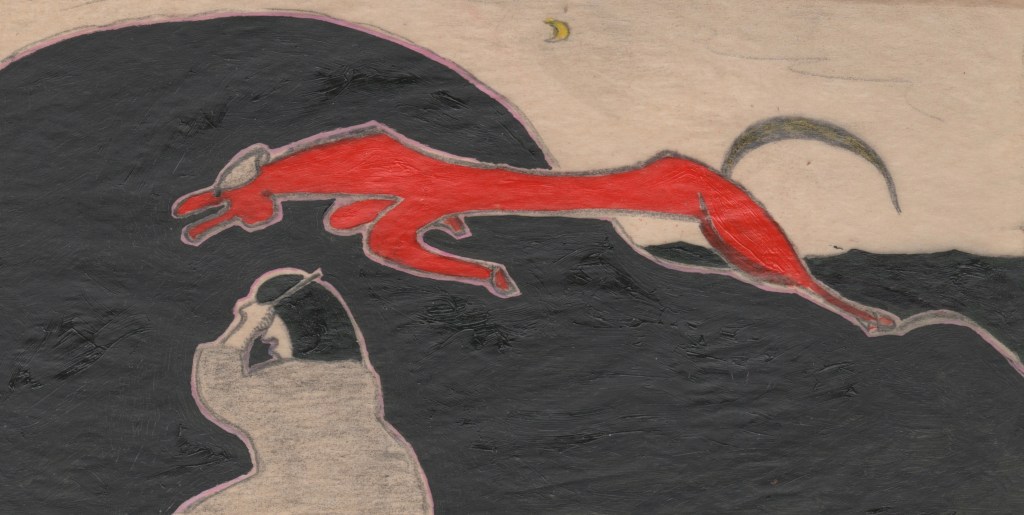
One of Lanyon’s primary concerns is now with a type of humour that was well expressed when someone wrote: “Your book makes my mascara run so I can’t read it on the train.” But he continues to paint and explains why with the analogy of the moment of release of a glider from its towrope: “One experiences a dramatic silence… the serenity is tangible. One never achieves such elevated calm when landing back on the noisy tarmac of text.”
Resident artist Dave King shows drawings, prints and sculptures including works made in preparation for or based on his installation at Wells Cathedral in 2021 – see Dave King Profile. Early works from the 1970s were often seen as formalist, a fashionable term at the time when it was thought aesthetic choice made up the principal matter of the work. On the contrary, his pieces have always contained an underlying poetic narrative alongside the usual considerations of making sculpture, such as material and scale.
Andrew Lanyon
FOUND: Jenny Graham, Jacy Wall, Dave King
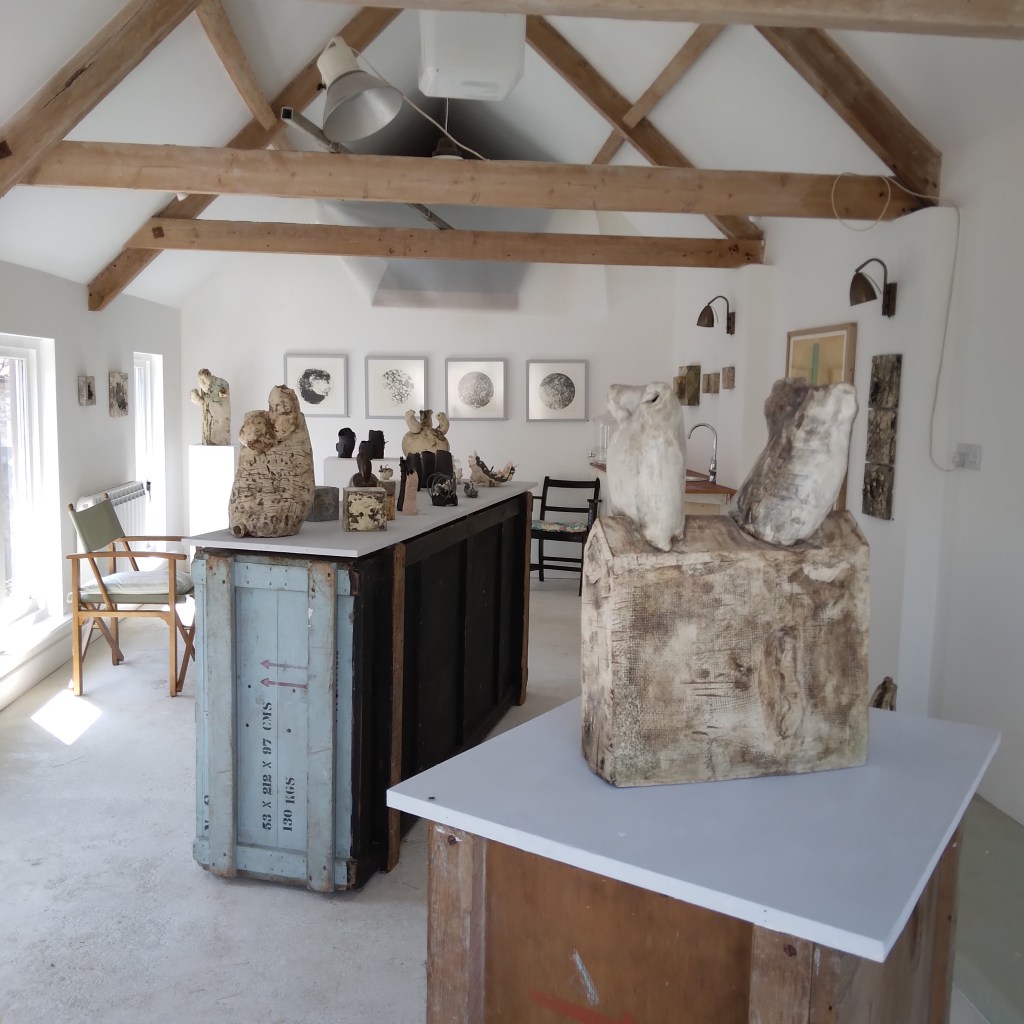
The three artists featured in FOUND: A Visual Conversation about the Land are based in the West Country and whether working with printmaking, drawing, ceramics, plaster, textiles or sculpture, all respond to their environment in unexpected ways.
Jenny and Jacy have taken risks with their main skills and explored new ones, each making work that provokes new perceptions. The ground has been the starting point for these works: mud, stone, shadows, neglected woodlands, the casual archaeology of found objects.
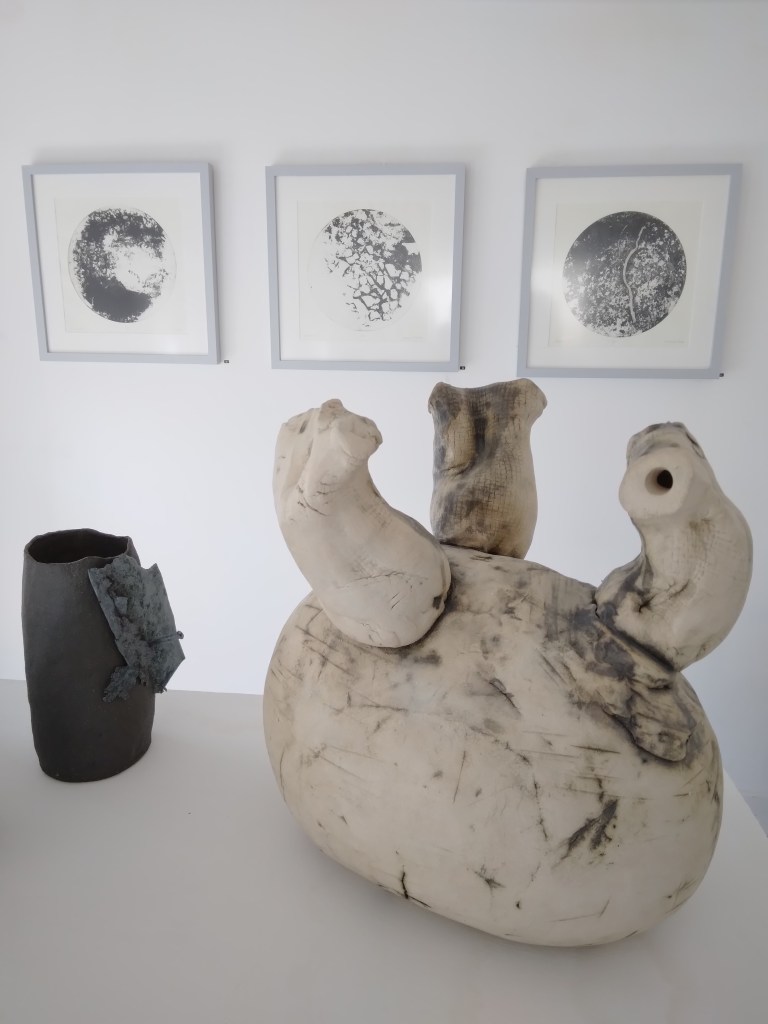
Dave shows previously unseen ceramics. He turns to fired clay for its plasticity and directness, extending interests in architectural metaphor, family relations and reverie that inform his better known mixed media sculptures.
Jenny is known for her distinctive landscape paintings found in many galleries in Somerset and Gloucestershire. Over the years she has also been involved in experimental works, most recently The Archaeology of Destruction at the Eastville Project in Yeovil with composer Stephen Ives.
Jacy is an abstract artist, principally a tapestry weaver, known also for printmaking and recently sculptural ceramics. Her work was represented at the London Art Fair 2020 and Crafts Council Collect Fair in London 2021 and 2022.
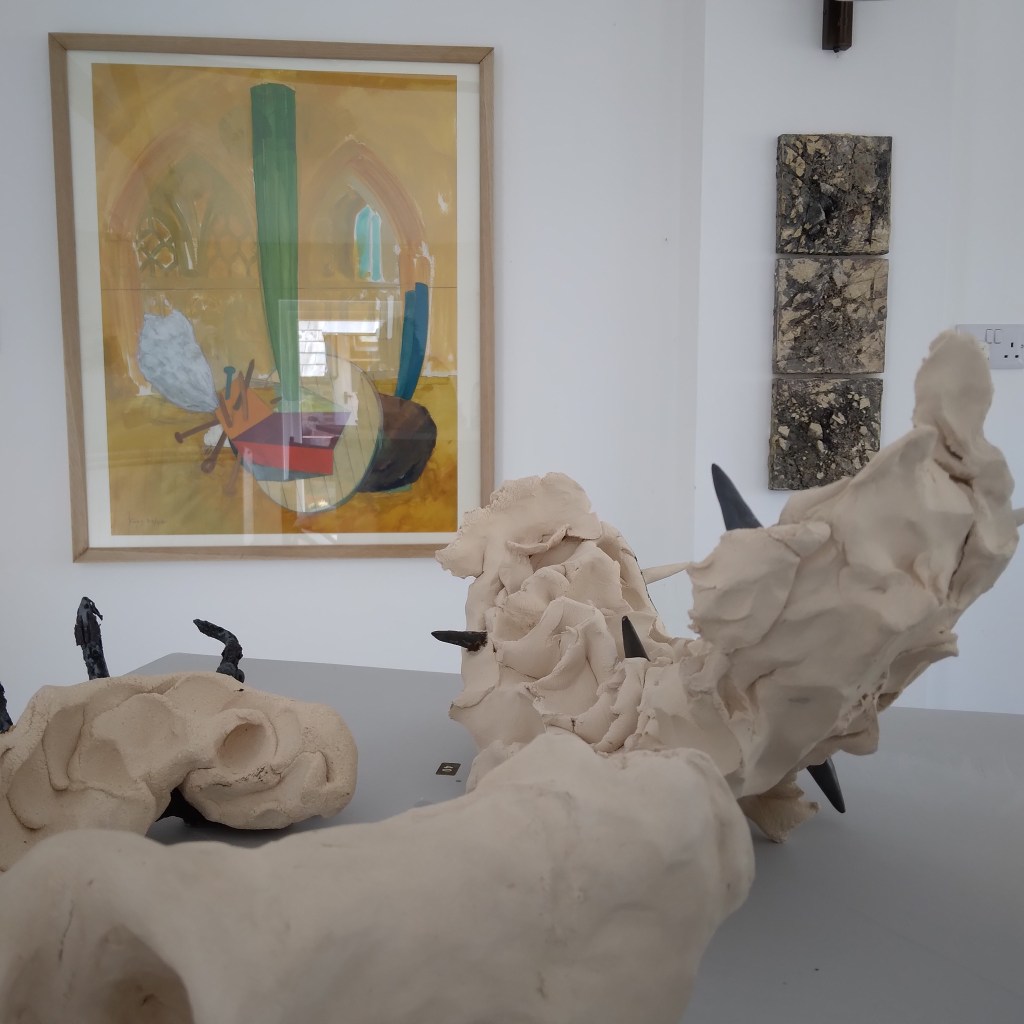
Dave has a long career as an abstract sculptor across a wide range of materials and forms from small pieces to larger commissioned public works. In 2021, as part of Wells Art Contemporary, he made a dramatic 10 metre high installation for the cathedral south transept. The colourful drawing above, Ecumenical Matter, is a development of the idea.
http://www.jacywall.co.uk http://jennygraham.co.uk
DAVE KING: THEN & NOW
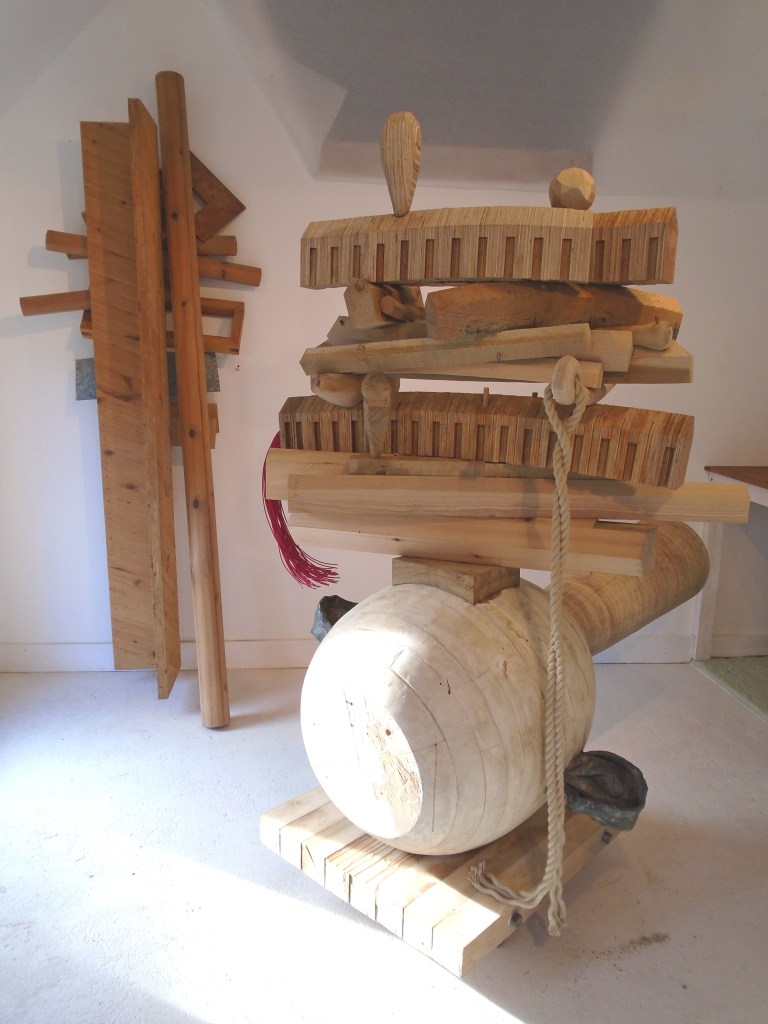
OBJECT FOR PARIS (Wood, metal 1980) and THINK SLOW, ACT FAST (Wood, bronze, wire, rope 2019)
Then & Now features Dave King’s most recent commission Think Slow, Act Fast, an autobiographical piece for A Good Age at the Devon Guild of Craftsmen last autumn. This is shown alongside rarely-seen constructed wall-based wood and metal sculptures exhibited in the 11th Paris Biennale in 1980. There is also an extensive range of drawings made over the last 50 years. Much of the distinctive character of King’s work and of his visual ideas has evolved through drawing. Interviews with King while making Think Slow, Act Fast are on YouTube in a film by Jess Pearson. Key words: A Good Age project Devon Guild of Craftsmen with subtitles
GENERATIVE DRAWING – PARALLEL PATHS SUMMER & AUTUMN 2019 DRAWING AND SCULPTURE BY JOEL FISHER & DAVE KING
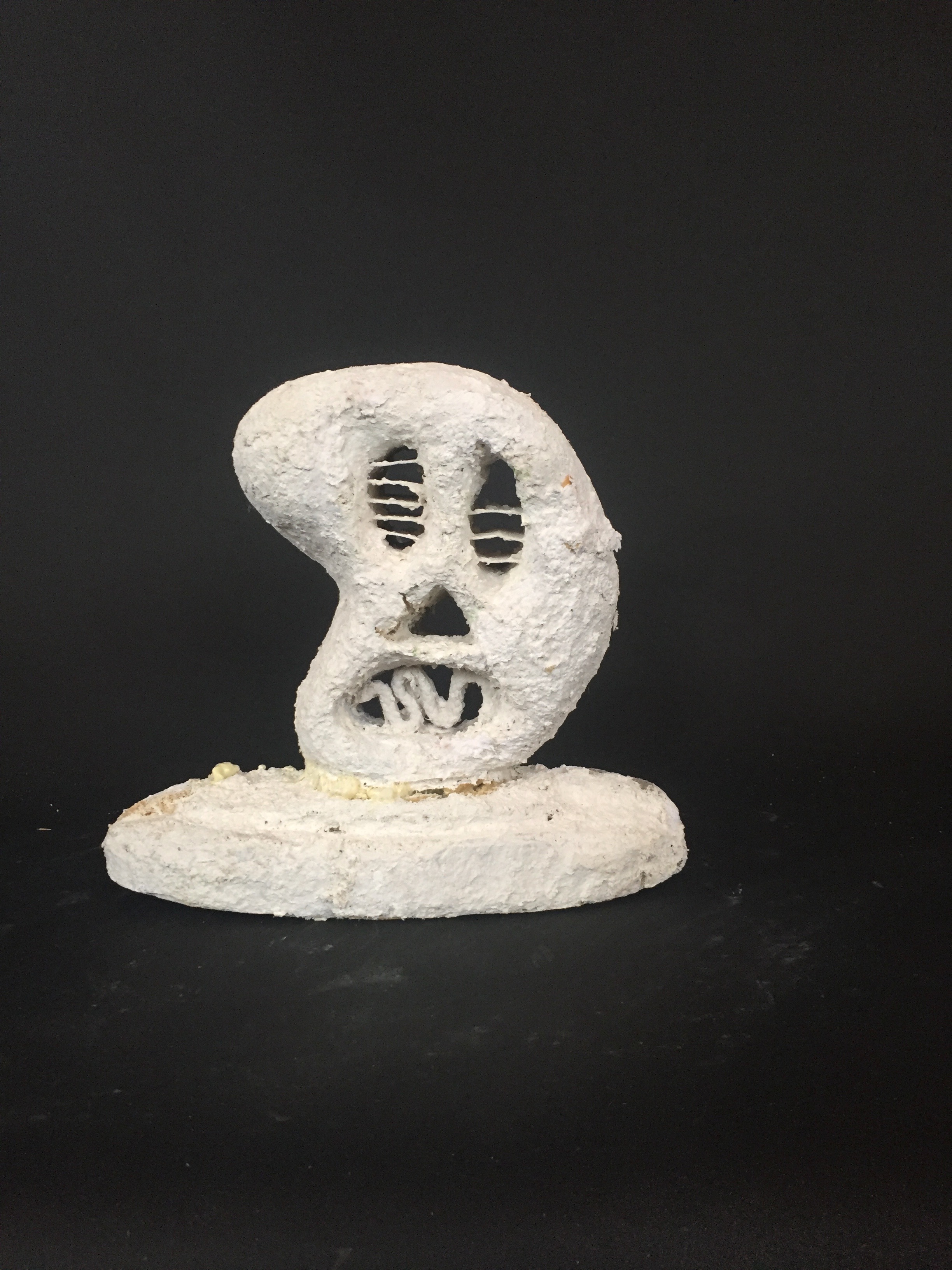
This exhibition paired artists who have been friends for over 40 years. They both lived in East London at a time when affordable housing and studio spaces became available there for artists making their way.
Key themes of the exhibition were repetition and sequence. For Fisher this involves development of imagery via a sequence, like Chinese whispers, where each person in a chain is invited to memorise what was drawn by the previous person and reproduce it. After 30 to 40 such interventions Fisher makes sculpture from the newly evolved and now considerably altered drawings. “As each image is passed from one mind to another, a tiny dollop of nourishment is added,” he wrote in (Self) Portraits: Invisible Potential and The Fugitive Self.
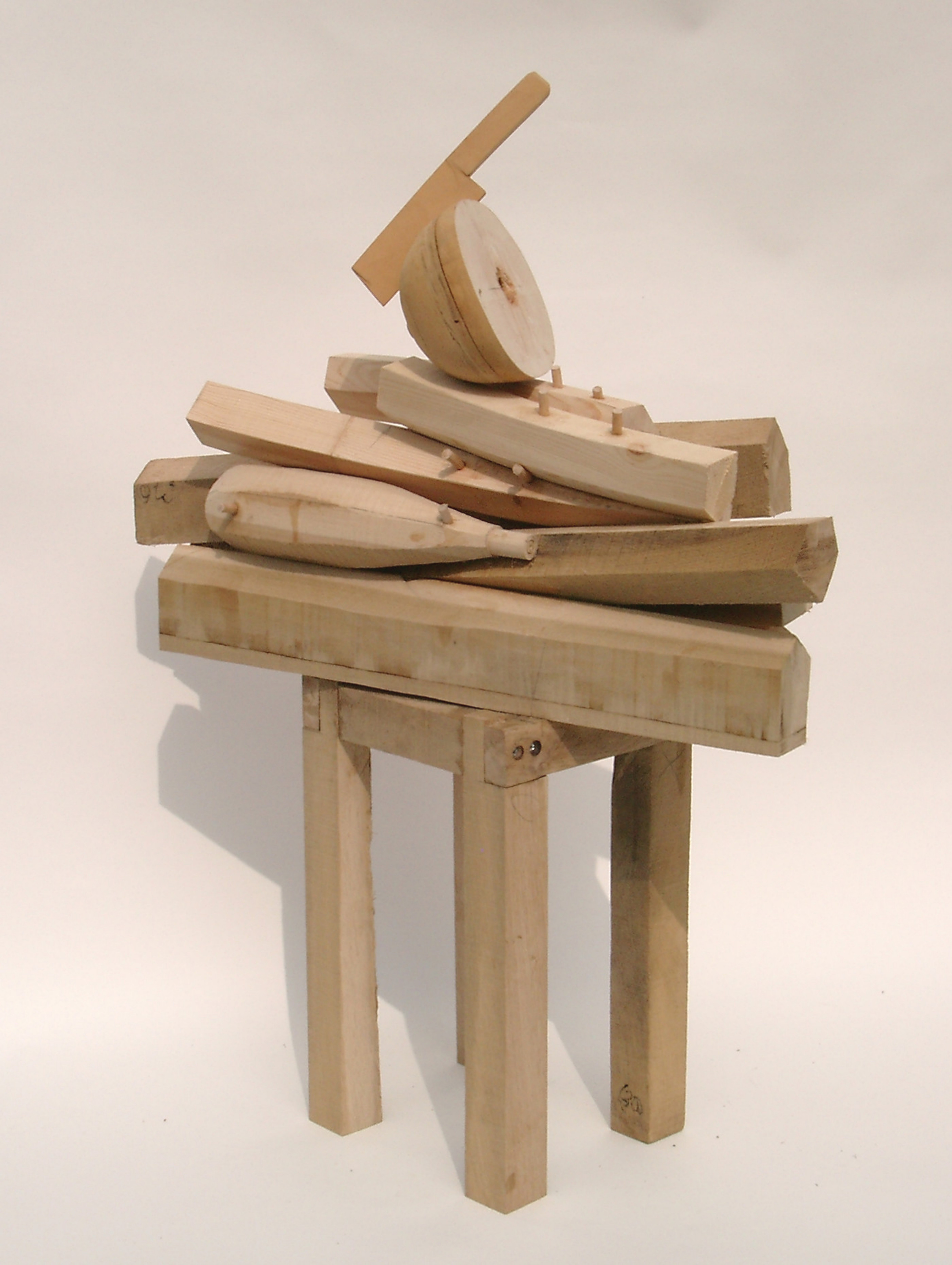
For King drawing is a key rehearsal for making sculpture and through repetition and variation leads to the refinement of ideas. Drawings – valuable in their own right – are only fully tested when realised in three-dimensions as the reality of working with materials takes over, as in two “rehearsal” sculptures for his commission for A Good Age: Change in Our Time, an exhibition at the Devon Guild of Craftsmen, which were included.
Fisher, an American now based in Newcastle-on-Tyne, has worked for most of his career with hand-made paper often with watermarks woven into sheets, and used surface imperfections to develop images then sculptures in wood, plaster and bronze. A student work involved ingesting paper to prove a point to his art history professor.
Above: Joel Fisher Papier-mache sculpture from drawings in the 1000 Series 2019. Below: Dave King Husks 2019.
Abstract Reflection – Winter 2019
Below: Abstract Reflection with Dave King’s sculpture Palace of Memory and Communication 2018 and Patrick Jones’s paintings (left to right) Moonscape 2018 (top), Horizon 2018 (below), Mirror 2018, Red Star 2017 and Fragment 2017
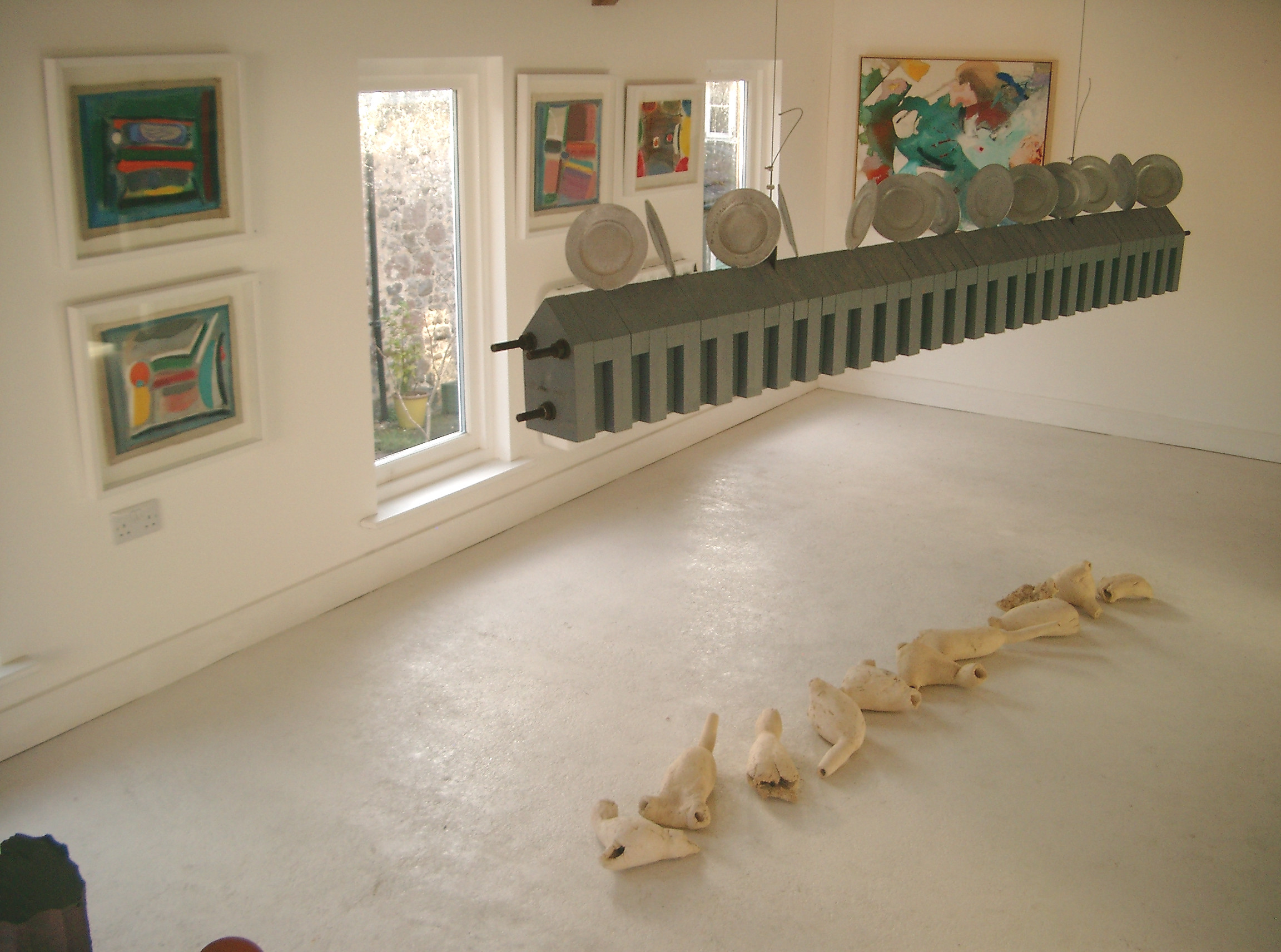
For Abstract Reflection, the first exhibition in 2019, Dave King’s latest sculptures – ceramic, found and cast metal with painted wood – together with drawings for a new commission are shown alongside recent small paintings by Patrick Jones, known for large, gestural, vibrant works. Having lived and worked in the US at different times, both are now based in Devon.
King’s commission is one of five awarded by the Devon Guild of Craftsmen to older professional artists for an exhibition A Good Age: Change in My Time to be held at the Riverside Gallery, Bovey Tracey in September. King will add further drawings and maquettes throughout the run of Abstract Reflection, which features his new suspended sculpture Palace of Memory and Communication 2018.
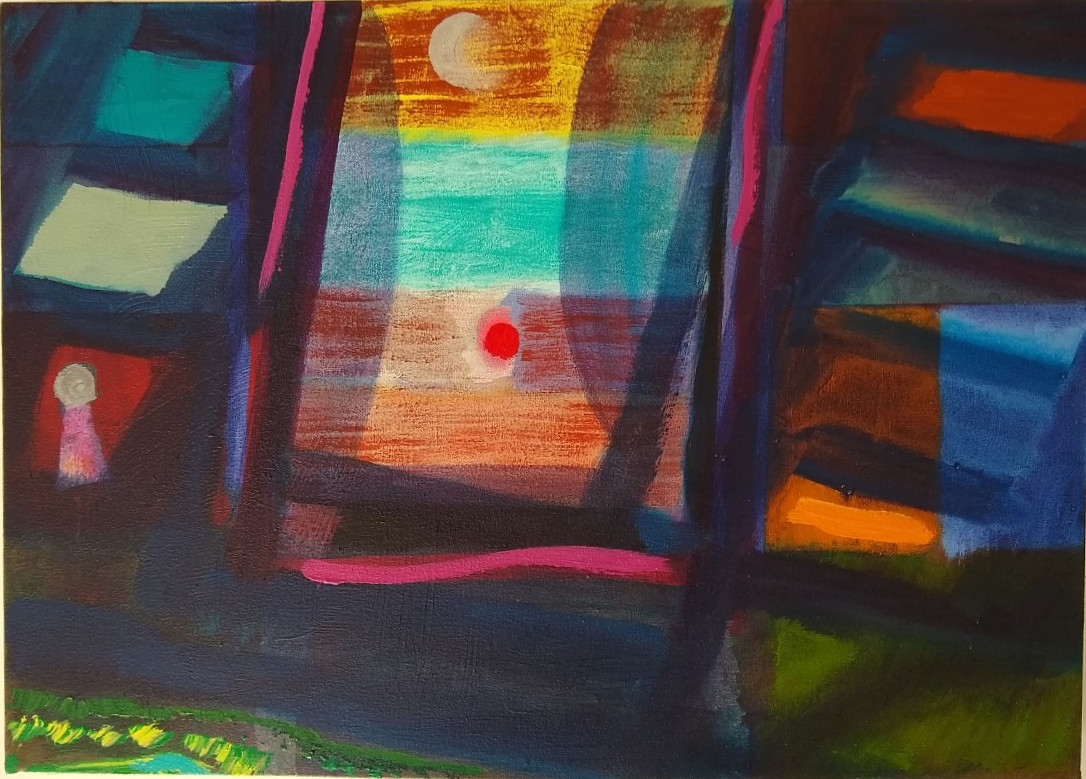
In speaking of his practice, Jones rightly stresses its egalitarian aspect. He describes himself as “an abstract painter who wishes to make exciting, colourful and complex images that can be enjoyed by all members of society through the act of looking and reflecting on the thought process involved.” His work engages viewers by its vital immediacy and his paintings convey both joy and mystery, as in Moonlight 2018 above.
Until April 28. Open Wednesday and Sunday 2pm to 5pm and on most days 10am to 5pm by prior arrangement: 01460 220021 alisonoldhamart@googlemail.com
Appeto: Public Art & Private Worlds – Summer 2018
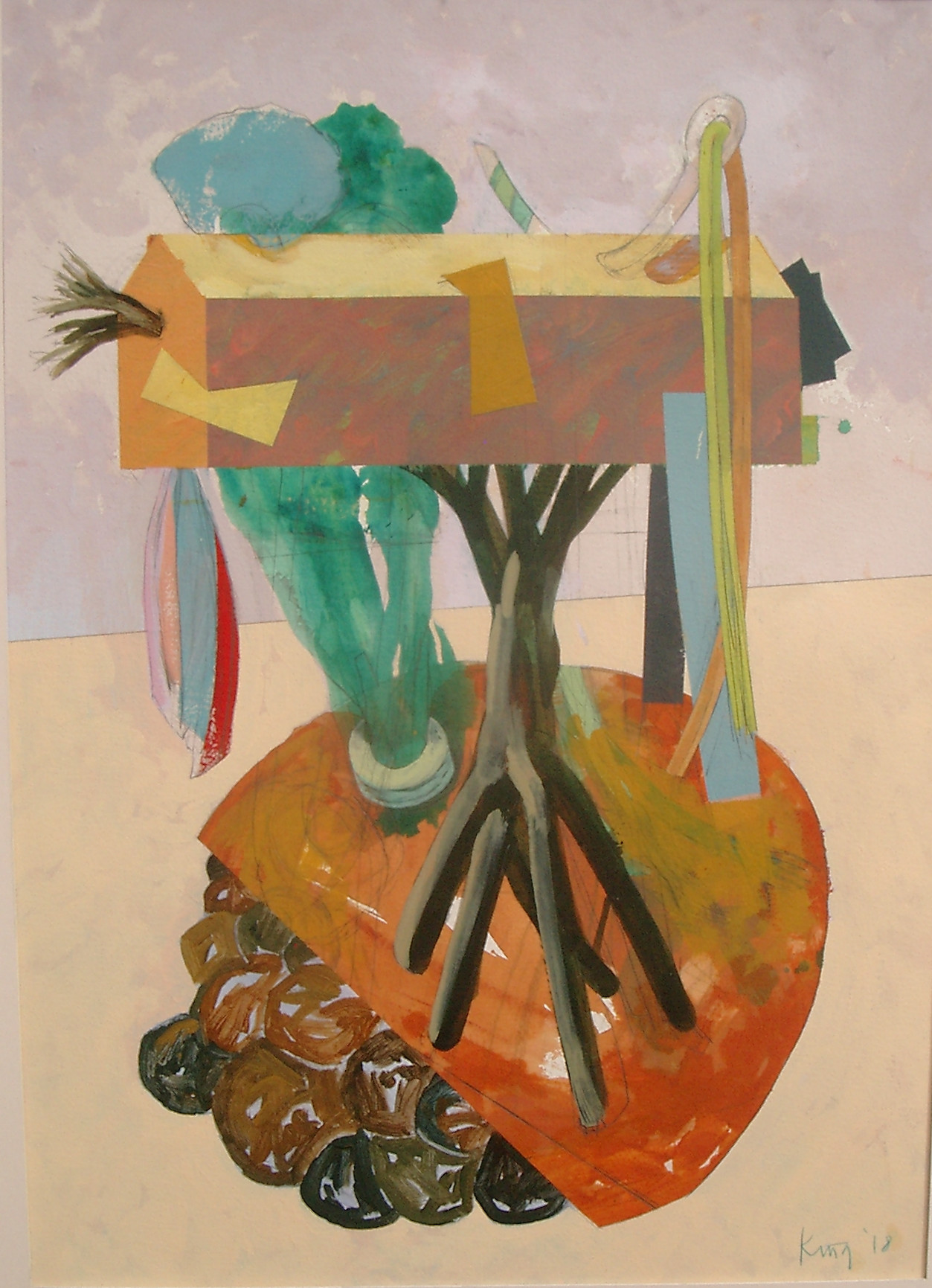
Appeto is a Latin verb meaning to strive after or grasp after a thing. The concept applies equally to the work of sculptor Dave King and painter George Sherlock. Although their approach and backgrounds are distinctly different, surface and water are common concerns in the art of both, as are the seen and unseen.
In King’s drawings, prints and sculpture the imagery is largely metaphorical so, for example, the roof of the house becomes a watery wave carrying improbable and impossible objects together with balanced figures or sailboats. In a key anecdote from a favourite book, The Poetics of Space, Gaston Bachelard relates how Gustav Courbet, looking out from the top of the Sainte Pelagie prison, felt an urge to depict Paris “the way I do my marines: with….. all its houses and domes imitating the tumultuous waves of the ocean.”
In the past an excitement at the prospect of making larger sculptures led King to an interest in public art with several works produced, sometimes on a temporary basis. But the dilemma for an artist with such idiosyncratic and personal interests is how these concerns translate into an art with common meanings for the public space.
A recent kidney transplant encouraged King to think of the longhouse as akin to the body, where surgical intervention requires repairing skin with needle and thread to close up after the operation.
King was born in Birmingham in 1946 and studied at Leeds College of Art and the Slade. His distinguished career includes mixed and solo gallery exhibitions, commissions and opportunities to build large sculptures abroad, notably in Ireland and North America.
King and Sherlock first met in 1991 as visiting lecturers in fine art at Coventry University and have subsequently exhibited together, with others, in Porto and Coventry after Sherlock was instrumental in establishing exchanges of art, students and staff between the cities.
George Sherlock was born in Liverpool and studied at Liverpool College of Art 1959-63. He has a lifetime association with the sea and has crossed the Mediterranean, Atlantic and Pacific by sailing yacht.
The paintings in Appeto are from his current series of smaller works. “They grew out my experience of water: its energy, transformation, flow, pollution and relation to global warming. The amazing images nature creates by the reflection of light on its surface are well known through the genre of marine painting and works such as Monet’s Water Lilies. There is a historical reference to Leonardo da Vinci’s studies of water and my previous series Deluge and Tamesis.”
Deluge I was the main prizewinner in the Royal West Of England Academy’s historic Open Painting Exhibition, the first “open” in 157 years eliciting over 1,300 entries. It was made by the transfer method, which evolved from experiments in mixing acrylic with domestic chemicals and polymer house paints. Deluge I was executed with large brushstrokes but current work is more informal; paint spreads out and settles in structures over several weeks.
“Images are painted on the studio floor where polythene is turned into a shallow bath in which paint is allowed to mix and separate according to the quantity of water used. The process allows for extraction and addition of water and new paint which generates unexpected configurations. The image is reversed through printing onto a surface or viewed through the polythene.”
Exhibitions have included the John Moores Painting Prize 1969 & 2010, I/Am/Is/Are – a solo show in Porto in 1998, RWA “Open” in 2001, The Sunday Times Watercolour Competition 2010, RWA Autumn Exhibition 2012 and Rugby School Drawing Prize 2014.
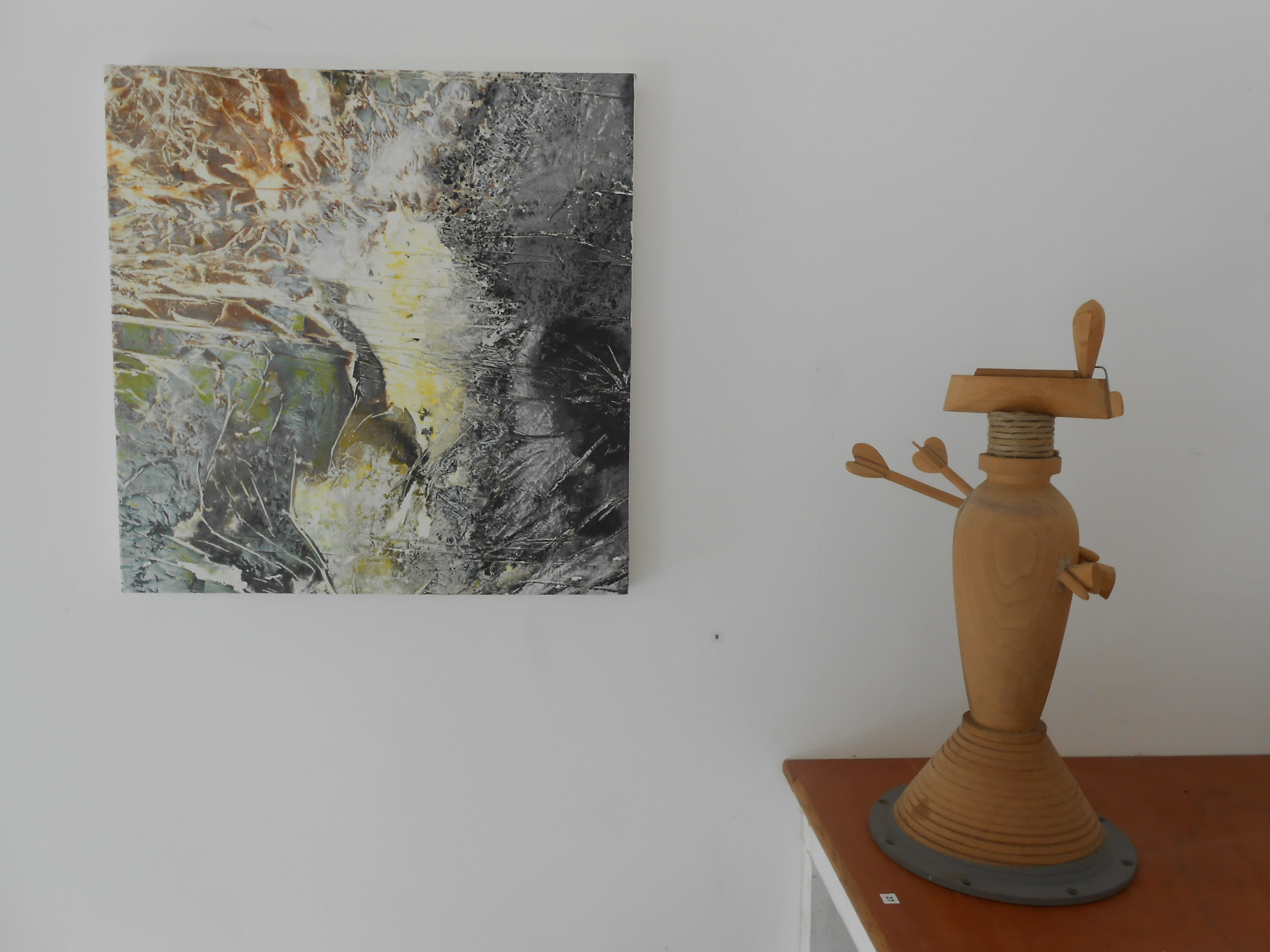
Below: Daniel’s Bay by George Sherlock and maquette for Coventry Canal Basin proposal by Dave King. The title of Sherlock’s painting comes a bay surrounded by high rocks with a near-hidden entrance, on Nuka Hiva in the Marquesas Islands.
===============================
INAUGURAL EXHIBITION – SEPTEMBER 2017 TO EASTER 2018
SCULPTURE AND DRAWINGS BY DAVE KING, PAINTINGS BY DIANA KERSWELL
Dave King’s sculptures include references to literature and history as well as the everyday. In early work he explored the impossibility of clouds captured on stalks. These were large works with a surrealist streak that was also played out in his drawings and prints of the early 1970s.
It is the unlikely combination of imagery in his sculptures that marks his work out as being highly individual, and which carries a message beyond its literal appearance. He uses association and metaphor to great effect. The house motif, and rooftops in particular, recur frequently in his mixed media sculptures.
Architectural elements are used for the messages or stories they can convey. Rooftops may support a dancing figure, a boulder or plates and bowls – simple domestic appliances that reflect information about the interior – but it is the other strange forms that test the viewer.
Wood, found objects and metals in all manner of construction techniques give a rich flavour to King’s work. Some are painted, others exist in their raw state; all are finished with skill and precision.
From the Cass Sculpture Foundation website
Dave King was born in Birmingham in 1946, studied at Leeds College of Art and the Slade, has exhibited widely since the 1960s and has works in international collections.
http://www.devonartistnetwork.co.uk/artists/dave-king

Diana Kerswell is a painter/printmaker who was born by the sea in Hampshire and now lives by the moors in Matlock, Derbyshire. She studied Fine Art at Middlesex University and the Sir John Cass School of Art in Whitechapel. Since moving to the Peak District her paintings have been inspired by topography, prehistoric sites and industrial history both there and elsewhere in the British Isles.
“I try to convey through my paintings the subtle changing light, atmosphere, moods and the weather on the land and my response to these. I often draw in Chatsworth Park, landscaped by Capability Brown, and also in wilder locations – Dartmoor and the Lizard.”
The Shippon Gallery has The Duke of Devonshire’s Trees, based on drawings made in Chatsworth, Listen to the Land, inspired by Wistman’s Wood on Dartmoor, and Over the Hill and Under the Hill, whose source was the Peak District limestone geology.
Recent exhibitions include Cill Rialaig, Co Kerry, Eire (2017), British Contemporary Art at the Millinery Works Gallery, London (2016) and “One story is not enough” at the Salthouse Gallery, St Ives (2015).
Website: DianaKerswell.com Email: dmk@stanage.me.uk
 Shippon Gallery
I remember Dave King’s evocative pieces at the James Hockey gallery in Farnham, one particularly fine poetic sculpture called Winter fish Trap if memory serves. A circular impenetrable high wall of wood that you could walk around but never find a means of entry, except through reverie and imagination, as you were greeted on approach from a distance by the tantalising emergence of a wooden ladder and crisp rooftop – clearly contained within but teasingly beyond reach.
LikeLike
Many thanks, James. An accurate and well-remembered description of those pieces from so long ago. In better times do visit us at the gallery. With kind regards, Dave
LikeLike